
Tuesday, August 11, 2026
I worked on this piece with with Inessa Createssa, a COPA judge about the evolution of digital content, what separates outstanding work from average content today, and why publishing professionals should not ignore social media.
Q1: As someone who judges international awards and works closely with creators and brands, what changes have you seen in digital content over the past few years?
Inessa Createssa
 |
|
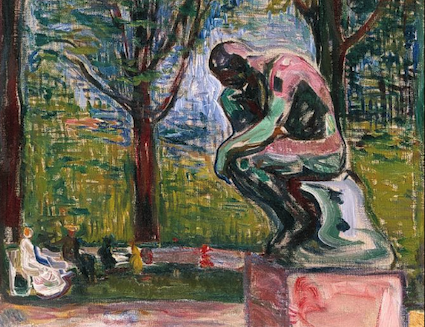
Rodin's The Thinker (in the park of the Lindesche Villa with the family in the background) by Edvard Munch
|
Q1: As someone who judges international awards and works closely with creators and brands, what changes have you seen in digital content over the past few years?
Inessa Createssa
One of the biggest shifts is that audiences have become much better at recognising what feels genuine and what feels manufactured. A few years ago, visibility was often achieved through volume, trends, or simply by publishing more content. Today, attention is much harder to earn. People are constantly exposed to information, which means they naturally gravitate toward content that feels human, specific, and emotionally relevant.
As a judge, I notice that the strongest entries are rarely the ones with the biggest budgets. They are usually the projects with the clearest point of view. The work feels intentional. It understands its audience. It knows exactly why it exists and what it wants people to feel.
We're also seeing a shift away from polished perfection toward personality. Audiences want expertise, but they also want perspective. They want to understand who is behind the work and why it matters. That applies equally to publishers, journalists, creators, and brands.
Martin Seto
Depending on the time frame, If you look back at our 18 year industry, publishing has changed dramatically as technology has made it easier to connect directly with readers and the need to transform themselves into a multi-platform brand to survive. First was the website/email, web browsers, pay per click ad market, SEO, social, mobile devices, big data (salesforce), cloud computing and now AI.
Publishers of all sizes are forced by the market in expanding the content distribution in print, website, email, social, podcasts and video. This market pressure and the duopoly of Google and Meta in the digital ad market left little revenue to invest in these initiatives. But without content there is no internet.
What has not changed is human instincts, today’s generation may engage content differently than previous generations, but they are better educated and informed and trust is earned not given online. They just happen to see a video clip or listen to a podcast versus traditional media.
What has not changed is the need to be authentic. That means words/actions that are real, not corporateese to connect with the reader. That they can trust. The media has played that role in many forms.
- Investigative Articles
- Breaking News
- How to stories
- Product Reviews
Media has achieved that trusted brand status, but now has been partially replaced with online review ratings in the consumer buying process.
What has not also changed is the negative news bias of human nature too. Meaning ” Everybody Like a Train Wreck”. This gets eyeballs. This negative bias has side effects as stories are skewed negatively to get eyeballs, clicks and article reads.
Now with the advent of new digital tools this has been amplified on line and some can be considered scam-like as they try every emotional lever including greed, sex and other tricks to get your attention. (The problem with an unfiltered internet) The early versions were fartciles (fake articles) and today they are AI generated with fake footage. Today’s digital content clutter, that is just noise and ignored in most cases, but all they need is 0.1% and there are enough suckers out there to meet that number.
Publishers today are using AI for story research, reporting, infographics and political cartoons and this is a major change in content creation in the past year and more to come as the tool is embraced and continues to evolve.
 |
|
|
Q2: Many publishing professionals still feel sceptical about social media. What would you say to someone who loves writing but doesn't want to become an influencer?
Inessa Createssa
I completely understand that hesitation because I hear it all the time. Many writers, editors, journalists, and publishing professionals assume that building an online presence means dancing on TikTok, constantly filming yourself, or turning your life into content. In reality, social media is simply a distribution tool. The goal is not to become someone else. The goal is to help the right people discover your work.
I completely understand that hesitation because I hear it all the time. Many writers, editors, journalists, and publishing professionals assume that building an online presence means dancing on TikTok, constantly filming yourself, or turning your life into content. In reality, social media is simply a distribution tool. The goal is not to become someone else. The goal is to help the right people discover your work.
One idea I often share with clients and readers of my book is that you don't need to copy someone else's format. The most sustainable content strategy is usually the one that feels natural to you.
If you enjoy writing, your content can be text-first. If you enjoy analysis, you can share insights. If you enjoy teaching, you can create educational posts. If you're comfortable on camera, video can become part of the mix. There is no universal formula.
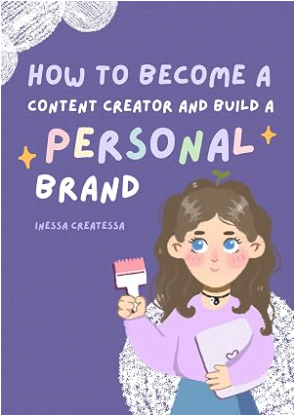
In my e-book, I discuss the importance of choosing a format that matches your strengths rather than forcing yourself into trends that don't suit your personality. Consistency becomes much easier when the format feels natural. The people who succeed online are not necessarily the loudest people. They're often the people who find a communication style they can maintain for years.
Martin Seto
Rule 101 in marketing communications is define your target market and find channels that fit the demographics of your market. This rule applies to social media selection, if you do them all you have no focus. Social media is the foundation of anybody's digital footprint today. This is how you reach new people, stay connected and interact one-on-one. The world is upside down now.
As an actor the importance of maintaining visibility on social media is a must. If you are not there is some form you will get forgotten, but the content you post has to be customized for each channel. You need a multiplatform social media strategy, you don’t have to do them all. I have a Youtube Channel for my acting reel, and use FB and IG to post some acting gigs.
Now remember this is a two way channel and I get to interact with casting agents in casting groups on Facebook for gigs. This works because my nephew Aaron Paris, a Juno/Grammy award winning musician posted some crazy IG videos and somebody in LA saw and the rest is history.
Now remember this is a two way channel and I get to interact with casting agents in casting groups on Facebook for gigs. This works because my nephew Aaron Paris, a Juno/Grammy award winning musician posted some crazy IG videos and somebody in LA saw and the rest is history.
Now as the producer of the COPA’s the strategy is different after experimenting over the years of the effectiveness of social media. We have settled on Linkedin and X. We use Linkedin to expand our footprint in the content creator/journalist community through the connections features and post updates on the COPAs. We use X to broadcast the Awards ceremony in real time with copies of the slides from the show. Zoom is the digital meeting channel.
But being an influencer requires some celebrity cache or sex appeal to get the attention of readers and that is not an easy thing to do and make money at it, unless you're in the Top 1%. Plus you will need a constant publishing schedule, sometimes daily in some cases. Also some influencers are disguised as brand ambassadors and they will not pass the “ Authentic Meter” and will not have a loyal audience. You are also competing against all the fake identities on the internet with fake audience numbers.
There are many forms of writing. There is a blog/column/article that can reach your inner feelings on a topic (meal size content), social media content is bite size ( 50 words, 15 second video), podcasts are a new form of long-form journalism. So today’s writers can explore whatever creative way to express themselves. With the advent of AI writers or content creators have new tools to create graphics, video, audio that was not available before in their tool box. What stands out is the human creativity hopefully.
 |
|
|
Q3: From your perspective as a judge, what makes award-winning work stand out today?
Inessa Createssa
The strongest work creates a connection before it creates a result. Of course, metrics matter. Performance matters. Impact matters. But when judges review hundreds of entries, what often stands out is clarity. Great work usually answers a few simple questions exceptionally well: What problem was being solved? Why did this approach make sense? What made it different? Why should anyone care?
The best entries also understand their audience deeply. They don't chase trends for the sake of trends. They use creativity strategically.
Whether it's a publishing project, a marketing campaign, or a creator initiative, memorable work tends to leave you with the feeling that it could not have been made by anyone else. It reflects a unique perspective rather than following a template. That originality is becoming increasingly valuable as more content is produced every day.
Martin Seto
What are the elements of an award winning article?
This rule has not changed in the history of journalism. An award winning article makes an emotional connection with their audience and helps move the social meter on a topic.
Now execution requires a good design/headline to capture the reader's attention along with words, photos, audio, video that may accompany the content execution that are informative, objective and entertaining in its tone and matter.
Now, what is an emotional pull for a judge is subjective and the COPA’s use a 3 judge panel for each category to minimize personal bias.
 |
|
|
Q: What advice would you give to creators, publishers, and brands that want to build stronger communities online?
Inessa Createssa
Inessa Createssa
Focus less on growth and more on trust. Many people approach content as a series of isolated posts. In reality, audiences experience your work as an ongoing relationship.
Communities are built when people repeatedly feel understood, inspired, educated, entertained, or supported by your content. Some of the most successful creators and brands today are not necessarily producing the most content. They're producing content that consistently reinforces a clear identity and a recognisable voice.
People follow expertise, but they stay for connection. When someone knows what you stand for, what topics you care about, and what kind of experience they can expect from your content, trust begins to form. Over time, that trust becomes community.
As the media and content landscape continues to evolve, opportunities for creators, publishers, journalists, and brands have never been greater. The challenge is no longer simply creating good work. It's helping to get that work to the audiences who need it most. Awards programs such as the Canadian Online Publishing Awards play an important role in recognising the people and teams pushing the industry forward, highlighting work that demonstrates creativity, innovation, and meaningful impact.
If you've created something you're proud of, this is your opportunity to share it with a distinguished panel of international experts, industry leaders, and experienced judges who understand what great content looks like across publishing, marketing, branding, and digital media. Your work deserves to be seen, and COPA is a place where exceptional work gets the recognition it deserves.
If you would like your work evaluated by accomplished industry professionals such as Inessa Createssa, I encourage you to submit it to COPA. Great work deserves thoughtful recognition, and the awards offer a valuable opportunity to have your efforts reviewed by some of the industry's most experienced voices.
Martin Seto
The holy grail of marketing is creating a one-on-one relationship with your audience on scale. Just like a personal relationship. You may talk business but you can mix personal in to make friends. That's right “Friends”. That is the end goal. Now how you reach that as publisher there is no simple answer. You also need audience milestones to make the math work. So you need to figure out what reach for your brand that will get advertisers attention.
There are many steps in the ladder of involvement to make "Friends” status. Publishers need a strategy for each stage. A website/email, social media and content marketing strategy will have to be created and maybe a media plan. Email spam laws make it very difficult to use lists unless you want to do it by snail mail. There is no way to do it like the old days, where a boating publisher I worked with started a magazine with a list of warranty card holders of boat motors provided by manufacturers, which will not work today.
Customer Ladder of Involvment
Customer Ladder of Involvment
Friends/ Brand Hero
- Opt-in paid subscriber/Customer - Highly valued
- Opt-in-in Free Subscriber
Dating/Brand Engagement
- Social Media Connections - Followers
- Social Media Likes
Checking you out/Brand Awareness
- Banner Ad clicks
- Seo Link click
- In Person Events
- Media Ad campaign
At the end of the day, you will need a marketing communications program that is multifaceted and integrated. The rule of thumb for each additional tactic the response rate increases by 40% . Free is a good offer to get attention with 70% better results. People are reluctant to give personal info without something in return. Contests and giveaways help build lists. You need a good offer to engage.
ABOUT Inessa
ABOUT Inessa
 |
|
|
Inessa Createssa, a COPA Judge is a content creator, marketing strategist, and author whose work focuses on personal branding, digital storytelling, and creator-led marketing. Her e-book on content creation and personal branding became an Amazon bestseller on its launch day, and she regularly works with creators, brands, and entrepreneurs on building meaningful online communities.
She also serves as a judge for several international awards programs, including the Canadian Online Publishing Awards (COPA), The Webby Awards, The Drum Awards and other leading industry competitions recognising excellence in content, marketing, branding, and digital communications.
 |
|
|
https://www.amazon.com/-/zh_TW/Inessa-Createssa-ebook/dp/B0F1QWCPL9
https://www.instagram.com/inessacreatessa/
Comment
Tweet
About Me
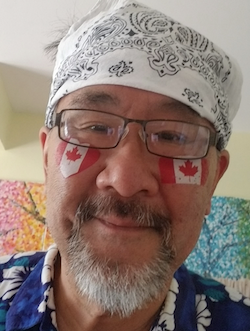
Martin Seto
 |
|
|
reflexmediasales.com or 416-907-6562, and on LinkedIn.
Most Recent Blog Comment
 |
|
| Lorene Shyba says: | |
Full of terrific information, Thanks!... |
|
Most Read Stories


